
Heather
Since 2020 I have broken through a significant number of brick walls in my genealogy, taking the vague ideas of “Austria … Serbia…. Yugoslavia… Old Country”. Heres my best collection of tips of how to get started finding documents for your American immigrant who was from that area:
1. Start with what you think you know
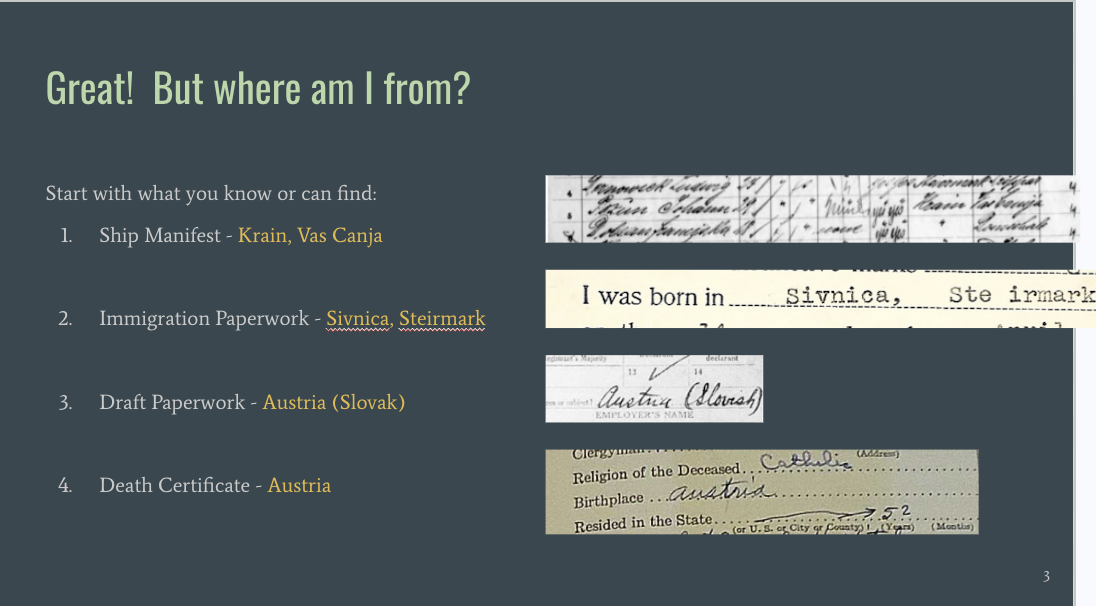
Seriously, gather everything and every document you have where your ancestor may have put down a home country or nationality. There is a good chance that 75% of what you have is irrelevant or not helpful for a variety of reasons, but there’s a good chance there’s a breadcrumb you’ll need! Hidden somewhere you may find a village name, or 3! Hold on to these. For example, here’s the list of places John Pozun had in his paperwork (put together for a genealogy society slide):
The folks over at ProjectAncestry have put together a great timeline that goes more in-depth as to how and these differences happened.
Generally speaking, most of my ancestors kept the culture and language of Slovenian, but during their lifetime they were ruled by Austrians, and then by Germans during WWII.
Here’s another great resource over at ProjectAncestry that describes various border changes and names (Krain, Styria, etc.)
2. Find it on an (old) map!
From here, my best guess was Sevnica for a village. I then went to Matricula, the online resource for birth, marriage and death registers for many eastern European countries. I find starting at the map interface helpful. From there I can find the Sevnica records. By starting to look around the time of my grandfather’s birth in the “Krstna knjiga / Taufbuch” I eventually flip around and find this image of the birth register!
This record matches the parent names I’ve seen on other documents and I eventually find his village as Canje, house 8, meaning his ship manifest was the most accurate accounting of his hometown! I’ve found this to be true of many of my family’s documents, that when completing the ship register, they shared their actual village, not just a general country or empire of rule.
Unfortunately, my next favorite site, Aracnum is now under a paywall, but looking at some of the early cadastral maps of the Austro-Hungarian Empire can give insight into Austrian and/or German names given to Slovenian locations.
And lastly, there is a great resource at Genteam.at, the Gazetteer, that gives a variety of old and new names for administrative areas. It’s always worth a quick search to help get you to the original records. There are also a few databases of other records that can help get you started so you can find an original record at Matricula.
3. Create a cheat sheet
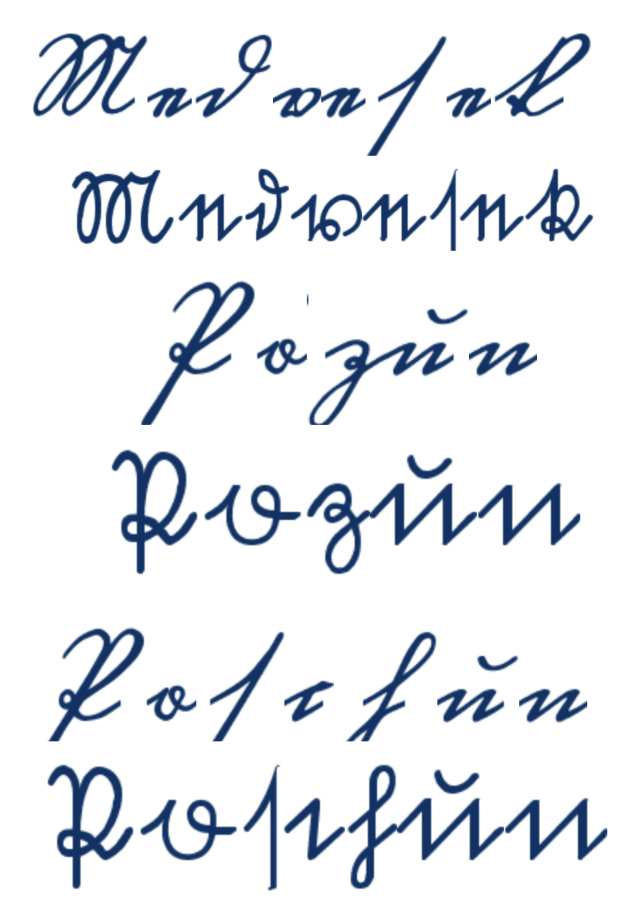
Register books are hard to navigate, moreso in Slovenia as they can be in Latin, Slovenian or German, depending on the prevailing rule. Additionally, when you add in Fraktur, Kurrentschrift and Sütterlinschrift, it’s a lot to keep track of! Stevemorse.org is one of my favorite resources. I generated versions of our last names including their German spellings (this you can sometimes find on ChatGPT, but will also likely stumble along as you navigate the church books). One of mine looked like this for Medvesek and Pozun.